



Your Dream of Studying Abroad in Spain Shouldn’t Be Delayed by Apostille Paperwork—But for Many Students, It Is!

Updated: Sep 7
Academic record apostille Academic record apostille Academic record apostille
Your Step-by-Step Guide to Apostille Facilitation for Studying Abroad in Spain
If you’re an international student dreaming of studying in Spain, you’re likely picturing vibrant culture, world-class education, and life-changing experiences—not navigating a maze of document requirements.
Yet behind every successful study abroad journey lies a critical, often underestimated process: properly preparing, notarizing (where required), and apostilling your academic records. The process flows from notarization (when applicable) to apostille, and any misstep along the way can result in delays or outright rejection.
That’s why working with the right professionals, both in the U.S and in Spain, is crucial not only to prevent rejections, but to guide you step-by-step with clarity, efficiency, and confidence. Plus, when you partner with a notary like me—who has a deep love for Spain and has been fortunate enough to visit three times—it’s truly a win-win, as I genuinely enjoy guiding students and living vicariously through your study abroad journey. In this blog, we’ll break down what that process looks like and focus specifically on the Homologation Student Program’s requirements in Spain but before we do that, you are thinking, “What is this thing called an apostille?”
What Is an Apostille and Why Does It Matter?
Before diving deeper into Spain’s specific requirements, it’s important to understand what an apostille is and why it plays such a critical role in your study abroad journey.
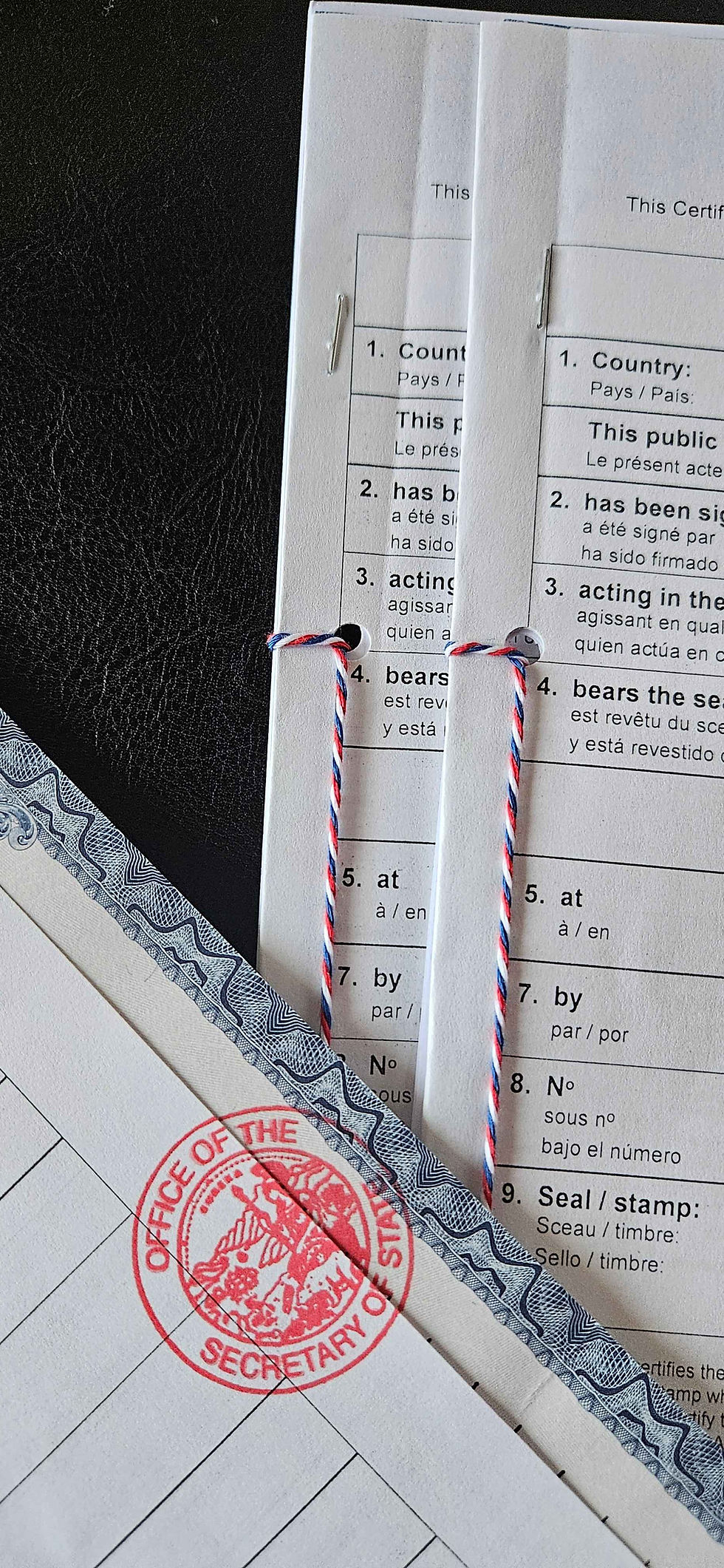
An apostille is a certification issued by a Secretary of State that verifies the authenticity of a public official’s signature on your document so it can be legally recognized for international use.
Since Spain is part of the Hague Apostille Convention, U.S.-issued academic documents must receive an apostille to be accepted.
From official transcripts and diplomas to enrollment verifications, letters of intent, and even identification documents—each must be handled with precision.
Understanding Spain’s Homologation Process
For students applying to academic programs in Spain, one key step is the homologation process, Spain’s official procedure for recognizing foreign academic credentials.
This is a regulated administrative process under Spanish law, and it ensures that your academic background meets national standards.
Whether you’re applying to a university, a graduate program, or seeking professional equivalency, your U.S. academic records must go through a strict validation process.
The Process in Simple Terms
Here’s the general process, simplified:
A document is issued and reviewed for validity
Based on the type of document, it may require proper notarization (depending on the document and state regulations)
The document is submitted to the appropriate Secretary of State where it originated
The Secretary of State issues an apostille verifying the public official’s signature
The document is translated by a certified sworn translator, typically after the apostille, in accordance with Spanish requirements
This structured process ensures your documents are legally valid for use in Spain.
Why Precision Matters in Spain
Spain does not focus on how documents look – it focuses on whether the authentication chain is legally valid. For this reason, Spain generally requires officially-issued academic documents, properly legalized or apostilled, as part of the homologation process.
Some common documents required include:
Official high school transcripts
Official diplomas
University degrees
Academic certifications
Supporting institutional documentation
Each of these documents must follow a specific chain of authentication and this is where apostille facilitation becomes invaluable. It’s not just about submitting paperwork—it’s about ensuring every document meets the exact criteria before it ever reaches the Secretary of State.
Supporting Students—Whether You’re in the U.S. or Already in Spain
One of the biggest misconceptions is that you must be physically present in the U.S. to complete this process. That’s not the case.
Whether you’re stateside or already living in Spain, your academic records can be:
Reissued by your institution (if available)
Properly notarized (when required)
Submitted for apostille processing
Delivered directly to Spain
With proper coordination, the entire process can be handled remotely and efficiently.
The Role of a Trusted Apostille Specialist
When navigating something as important as your academic future, having a knowledgeable guide can make all the difference. Working with a preferred notary—someone who understands both the notarization and apostille process—provides a level of assurance that’s hard to replicate on your own. Serving clients throughout San Diego County and beyond, Kristen operates as an extension of your team—whether you’re a student, parent, or educational consultant. Her approach is rooted in precision, efficiency, and clear communication, ensuring your documents are handled correctly the first time. She also partners with a nationwide network of notaries and apostille couriers, allowing her to assist clients locally and across the U.S., even under tight deadlines, expediting your needs from start to finish!
Why Working with a Preferred Notary Saves Time, Money, and Stress
Here are five key reasons why partnering with an experienced notary like Kristen ensures your documents are completed correctly the first time:
Expert Guidance on Document Preparation: Not all documents are treated equally. Kristen helps identify which documents require notarization, how they should be presented, and ensures they meet Secretary of State requirements before submission.
Error Prevention to Avoid Rejections: Rejections often happen due to small, avoidable errors with most rejections due to an improper notarization. With experience reviewing and preparing documents for apostille, Kristen minimizes the risk of delays caused by incorrect notarization or incomplete paperwork.
Streamlined Process from Start to Finish: From document pickup or printing to notarization and apostille submission, the process is handled efficiently—saving you multiple trips, confusion, and guesswork.
Expedited Services Through Trusted Partnerships: By partnering with notaries and apostille couriers across the country, Kristen offers both local and national support, ensuring your documents never leave the hands of a trusted partner and processed quickly—even under tight deadlines.
Peace of Mind During a High-Stakes Process: Knowing your documents are being handled correctly allows you to focus on preparing for your move abroad, rather than worrying about whether your paperwork will be accepted.
Local and National Support for International Success
One of the most valuable aspects of working with Kristen is the flexibility and reach of her services. While she provides convenient mobile notary services locally in San Diego County—meeting clients at their home, office, or a confidential location—her network extends far beyond. For students located outside of California, Kristen coordinates with trusted notaries and apostille couriers nationwide.
This means:
Documents can be notarized correctly in any state
Apostille submissions are routed to the appropriate Secretary of State office
Expedited processing options are available when timelines are tight
Communication remains clear and consistent throughout the process
This level of coordination is especially important for students applying to study abroad in Spain, where deadlines are often fixed and documentation must be exact. Another highlight to note is that your important documentation never leaves the hands of a trusted partner to ensure white-glove treatment from start to finish.
Understanding Spain’s Homologation Requirements in Detail
Based on the Spanish Ministry of Education, the format of your academic documents can be accepted for homologation—as long as specific conditions are met.
First, it’s important to understand that Spain does allow for a structure where:
The registrar embosses the original diploma or transcript
The registrar signs the original document
A notary notarizes that registrar’s signature directly on the document (often on the back with a seal)
This format is acceptable as long as the notarial act is clearly tied to the signature on the academic document itself. Spain does not require a loose acknowledgment page if the connection is clear and properly executed.
Non-Negotiable Requirements:
For your documents to be accepted, the following must be met:
Original, Official Documents Only Spain requires original diplomas and transcripts—not copies or certified copies.
Notarization Must Authenticate the Issuing Signature
The notary must be certifying the registrar’s signature, not a copy or separate statement.
Clear Notarial WordingThe notarial certificate must clearly identify the signer and their capacity.
Same-State ApostilleThe apostille must come from the same state where the document originated (e.g., California documents must receive an apostille in California).
If these elements are satisfied, Spain focuses on the integrity of the document chain rather than the physical placement of the notarization.
Breaking Down the Required Structure:
To ensure success, your documents must follow a very specific structure:
1. Institutional Signature (wet ink): The registrar or authorized school official must sign the original diploma or provide an official authentication letter that establishes the document’s authenticity at its source.
2. Notarial Acknowledgment: The notary’s role is not to certify a copy—but to authenticate the identity and signature of the institutional official. This step is critical, as incorrect notarization is one of the most common reasons for rejection.
Key elements include:
The acknowledgment references the academic document
The signer’s capacity (e.g., Registrar) is clearly stated
The notarization is directly tied to the original document
3. Apostille (Secretary of State): The apostille must authenticate the public official’s (notary public) signature—not a digital record or third-party certification.
This means:
The correct Secretary of State must issue the apostille
The apostille verifies the notary’s authority
The document is now valid for use in Spain
4. Translation Requirements: Another critical step in the apostille process for the academic records is the translation based on the receiving agency’s requirements.
Once your documents have been apostilled, the receiving agency in Spain often requires a certified sworn translation.
This translation must meet Spain’s legal standards to be accepted to fulfill the admission process for your student application.
Keep in mind, skipping or improperly completing this step can result in delays—even if the apostille is correct.
What the Apostille Facilitation Process Looks Like
To give you a clearer picture, here’s what working with a preferred notary partner typically looks like:
Initial Consultation: Completion of a preliminary intake form to gauge your notary and apostille needs.
Documentation Review: Review of your document requirements based on your program and Spain’s homologation guidelines.
Proposal and Payment Submission: A proposal outlining all services, steps, and timelines so you know exactly what to expect. Once approved, payment is collected to secure your spot to start the notary and apostille process for your academic documents.
Document Assessment: Determining which documents need notarization, which must be requested directly from institutions, and how they should be prepared.
Notarization (If required based on the document): Ensuring all notarizations are completed correctly, with proper language and formatting accepted by the Secretary of State.
Apostille Submission: Routing documents to the correct state office for apostille certification.
Tracking and Updates: Keeping you informed throughout the process via your preferred method (WhatsApp, text or email) especially if timelines are critical.
Final Delivery: Returning completed documents ready for submission in Spain, including guidance on next steps such as translation (if needed).
Avoiding Common Pitfalls
Even well-prepared students can run into challenges. Some of the most common pitfalls include:
Submitting incomplete or unofficial documents
Using incorrect notarization formats
Sending documents to the wrong state office
Underestimating processing times
Starting the process too late
The earlier you start—and the more guidance you have—the smoother your experience will be.
Why Experience Matters in Apostille Facilitation
Apostille facilitation is more than just submitting documents—it’s about understanding the nuances of international requirements and ensuring every detail is correct. Kristen, through San Diego Notary Signing Agent, has built a reputation for precision and reliability. With a 100% track record of success when assisting students applying to study abroad in Spain, her process is proven and trusted. Her Google Business profile reflects over 500+, consistent 5-star reviews, highlighting professionalism, efficiency, and attention to detail - qualities that are essential when handling time-sensitive academic documents.
Let’s Set Yourself Up for Success
Studying abroad in Spain is an exciting and life-changing opportunity— one that opens doors academically, professionally, and personally, however, the process begins long before you step on a plane. Your academic documents must be prepared with care, accuracy, and a clear understanding of international requirements.
Apostille facilitation isn’t just a task to check off your list—it’s a critical step that ensures your hard-earned academic achievements are recognized internationally. Think of it this way – just like you need a passport to travel internationally, your documents need their own form of “travel clearance”. Even though they’re official in the United States, they must be authenticated at the state level so they can be recognized and accepted abroad by the receiving agency, in this case, the Ministry of Education on behalf of the Homologation Student Services in Spain.
By working with a preferred notary partner who understands the process from start to finish, you’re not only protecting your timeline—you’re investing in peace of mind. From notarization to apostille, from local coordination to national support, having the right partner ensures your documents are done right the first time. Because when your future is waiting for you in Spain, the last thing you want is paperwork standing in your way.
Let Kristen take care of the details so you can focus on the excitement and joy of pursuing your dream – studying abroad in the beautiful, captivating, and highly sought-after country of Spain!
Working with a consultant like Kristen means you’re not navigating this process alone. You’re partnering with someone who understands the system, anticipates challenges, and ensures your documents are completed correctly the first time.
If you’re planning to apply through the Homologation Student Program in Spain, now is the time to take action.
Reach out today to get expert guidance, streamline your document preparation, and ensure everything is done right—so you can focus on the journey ahead, not the paperwork behind it.
📞 Let’s start the conversation today. Together, we can bring you and your family the peace of mind you deserve.
Kristen Weiss
Notary Since 2002
NNA Ambassador®
🌐 Just Google “San Diego Notary Signing Agent”
📱 Call us: (619) 663-6360

Comments